Production / Automation
.
Construction

3D Printing Technician (Construction)

Also posted as 3D Printing Technician (Construction) II; Sr 3D Printing Technician (Construction); Technician II

Typical pay range
$48k–$110k
Typical range · per year
Outlook
Growing
Entry barrier
Associate or cert
Two-year degree common, not required

What the job is

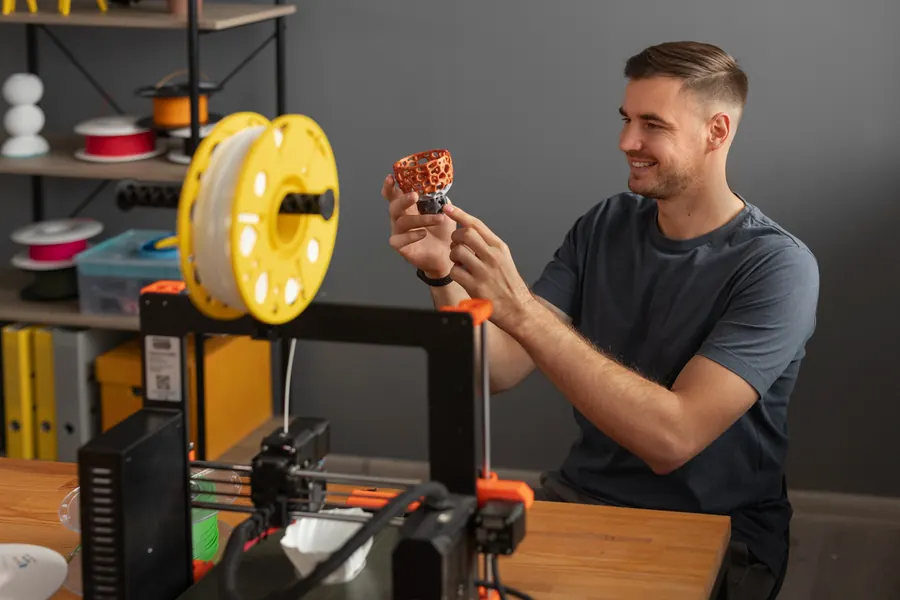
A 3D printing technician operates and maintains construction-scale 3D printing systems, preparing digital models, running additive equipment, and verifying printed structures meet spec. It's a hands-on job on construction sites and in fab yards, and many people start with a two-year associate degree or a focused certificate rather than a four-year degree.

3D Printing Technician (Construction)

The role profile

Everything you need to know about this role, the same details employers use to post openings and colleges use to build training.

Typical pay range
$48k–$110k
Typical annual pay based on national and industry data.
O*NET codes
17-3024.00
Primary and secondary occupational codes mapping this role to national labor data.
Cluster type
Construction
The broader industry group this role belongs to within the technician economy.
Context tags
Where and how this role is commonly applied.
Core skills
CADAdditive ManufacturingTroubleshooting
Essential competencies to perform this role effectively.
Canonical Role ID
UNM-TECH-043
A unique identifier linking this role across training, jobs, and employer systems.

How much does it pay?

Pay depends on the employer, location, certifications, and experience. Here is how pay typically grows over a career.

$48k–$110k
Typical annual pay range, based on BLS national data (May 2025) for Electro-Mechanical and Mechatronics Technologists and Technicians, the closest federal job category. The middle 80% of workers earn $47,840 to $109,890; the median is $73,900. Technicians who combine CAD fluency with equipment expertise typically earn at the higher end.

Source: Pay ranges use U.S. Bureau of Labor Statistics wage data and O*NET occupation profiles. Pay varies by state, employer, certification and experience.

Entry
Experienced
Specialized

What you would do on the job

Explore the core responsibilities of this role, from daily operations and equipment handling to safety, quality, and performance requirements.

01

Run additive equipment

Set up, operate, and monitor large-format printing systems.

02

Prepare digital models

Process CAD files and parameters so prints succeed the first time.

03

Monitor print quality

Watch builds, catch defects early, and verify finished work to spec.

04

Maintain print systems

Service pumps, nozzles, and motion systems between builds.

What skills do you need?

Three core skills sit at the heart of this role. You can learn all of them through short, hands-on training.

CAD

Using CAD software to read, prepare, and adjust technical models and drawings.

Additive Manufacturing

Setting up and running 3D printing systems to produce parts and structures to spec.

Troubleshooting

Isolating root causes fast using a systematic, test-driven approach.

How to become one.

Take a short, hands-on course to build the core skills, then apply to jobs hiring near you, all in one place, powered by the Unmudl Skills-to-Jobs® Network.

↗ Powered by Unmudl

Get job-ready
training

Short, hands-on courses and Skill Paths aligned to what employers actually hire for — built with colleges and industry.

↗ Powered by Unmudl

Find jobs
hiring near you

Connect with employers hiring for technician roles at every level. Browse live openings on the Unmudl job board.

Related roles.

back To Full Library

Frequently asked questions

A 3D printing technician operates and maintains construction-scale 3D printing systems, preparing digital models, running additive equipment, and verifying printed structures meet spec. It's hands-on work on construction sites and in fab yards.
BLS reports a national median of $73,900 a year for Electro-Mechanical and Mechatronics Technologists and Technicians (May 2025), the closest federal job category. The middle 80% of workers earn between $47,840 and $109,890. Technicians who combine CAD fluency with equipment expertise often earn toward the top of the range. Pay varies by employer, location, and experience.
Most people start with a two-year associate degree or a focused certificate program. You can find training on Unmudl to build the core skills, CAD, Additive Manufacturing, and Troubleshooting, then apply to open roles.
A four-year degree is not required. Many employers look for a two-year associate degree or a strong certificate plus hands-on experience, and demonstrated technical skill often matters more than the credential itself.
It's an in-demand role with a clear path to higher pay through experience and specialization. Demand is rising as factories, warehouses, and job sites automate (BLS 2024-34). The skills also transfer to related roles like assembly technician and CNC / machining technician.

Ready to start your
technician journey?

Get matched with training, apprenticeships, and employers tailored to this role.